

Our expertise
Cut-to-Length Lines
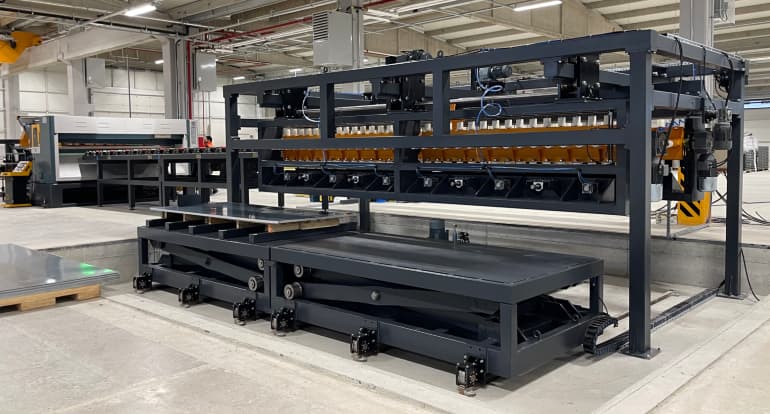
Complete lines that turn coils into sheets at exactly the length you need: straightening, servo feeding, guillotine and stacking — all built in our facility and managed by a single PLC.
Length accuracy
Servo feeding and encoder measurement cut sheet lengths within tight tolerances, with repeatability in serial production.
Clean cutting
The guillotine blade gap is set to the sheet thickness for burr-free, distortion-free cuts.
Single-point control
The whole line is managed from one operator panel via PLC; lengths, quantities and recipes are stored on the HMI.
Surface protection
An optional PVC film application unit protects sensitive sheet surfaces from scratches before stacking.
Why a Servosteel cut-to-length line?
Every unit, from the first link of the line to the final stack, comes from a single manufacturer: decoiler, straightener, feeder, shear and stacker are sized to each other. Compatibility problems seen in lines assembled from multiple suppliers are eliminated from the start.
Speed control uses Schneider Lexium and Altivar series drives; the line is fully assembled and tested at our factory before shipment, which keeps on-site commissioning short.
The line configuration is engineered to your sheet thickness, coil weight and sheet dimensions; if needed, it can be combined with a slitting unit to produce both strips and sheets.
Get a quote for Cut-to-Length Lines
Leave your name and contact details and tell us briefly which line you need; your request goes straight to our engineering team.
Call Us:+90 216 415 30 05From the field
The rest of the channel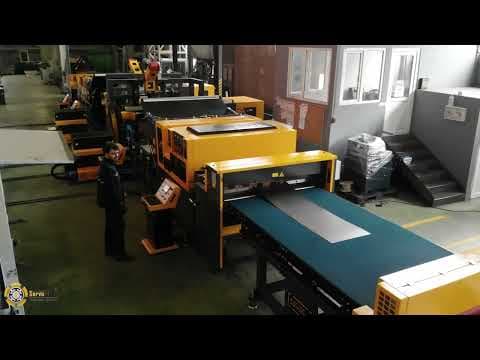
Frequently asked
Common questions about cut-to-length lines
What does a cut-to-length line do?
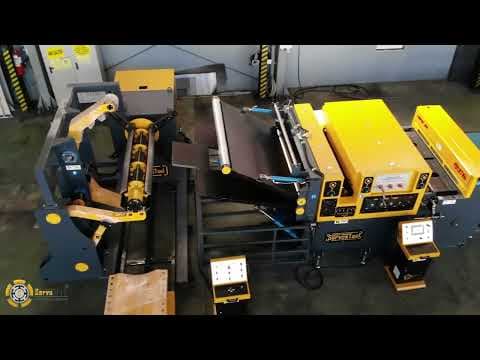
It uncoils, straightens and cuts the strip into flat sheets at the length you set. The output is not a coil but sheet to fixed dimensions. The line consists of a decoiler, straightener, servo feeder, guillotine shear and stacking unit.
Should I buy a cut-to-length line or a slitting line?
The difference is the shape of the output. A cut-to-length line cuts across the coil and produces flat sheet. A slitting line cuts lengthwise; the output is still a coil, in narrow strips. Choose cut-to-length if you sell sheet to fixed sizes, slitting if you sell strip. The two can be combined in one line.
How is sheet flatness achieved?
Coil-set memory is removed in the straightening unit, with roll pressures adjusted to the sheet thickness. The guillotine blade clearance is also set to thickness, so the cut is free of burrs and distortion. For sensitive surfaces, an optional PVC film unit protects the sheet from scratching before stacking.
What determines the price?
Coil weight capacity, sheet thickness and width, cutting accuracy and the level of automation (loading car, automatic stacking, PVC film) are the drivers. That is why we quote per project rather than from a catalogue.
What is CTL in steel?
CTL is shorthand for cut-to-length. A CTL line takes coil, straightens it and cuts it across into flat sheets at a set length. It is the opposite of a slitting line, which cuts along the coil and re-coils the narrower strips.
What is the difference between blanking and cut-to-length?
A cut-to-length line produces rectangular sheet at a set length — every piece the same simple shape. Blanking cuts a profiled outline, a contour defined by a die rather than just a length. If the part is rectangular, a cut-to-length line does it faster and with far less tooling; if it has a contour, it belongs on a press.
Who buys a cut-to-length line?
Steel service centres that sell sheet to fixed dimensions, sheet metal processors who buy coil because it is cheaper per tonne than sheet, and manufacturers whose own presses or laser cutters run on blanks. The decision is usually the same one: the coil price is lower, but the sheet has to be cut in-house to use it. We build the line around your coil weight, thickness and sheet size, and commission it on site.
Related reading
AcademyLet's engineer your cut-to-length line
Send us your sheet thickness, coil weight and sheet dimensions; we'll come back with a line layout and a technical offer.