

How to Choose a Cut-to-Length Line: 6 Decisive Criteria
Short answer
When choosing a cut-to-length line, sheet flatness is the deciding criterion: the cutting unit drives the price, the leveller drives satisfaction. Before requesting a quote, prepare coil weight and width, thickness range and grade, sheet length range and volume, and your flatness tolerance as a number. A flying shear suits short sheets in high volume; a stop-and-cut shear suits long sheets in low volume.
Contents
A cut-to-length line turns coil into flat sheets at a defined size. The difference from a slitting line is direction: slitting cuts along the strip, cut-to-length cuts across it and produces sheets. If you are undecided between the two, see the slitting vs cut-to-length comparison.
On this line, what the customer is really buying is the flatness of the sheet. Hitting the length is easy; producing flat sheet is where the engineering lives. The 6 criteria below put that at the centre.
1. How tight is your flatness requirement?#
Strip coming off a coil carries three kinds of shape defect, each from a different cause:
- Coil set — longitudinal curvature left by winding. The most common one.
- Crossbow — transverse curvature; the sheet bows up or down across its width.
- Edge wave — caused by the edges being longer than the centre; it originates in rolling and is the hardest to correct.
A simple straightener removes coil set. Edge wave and defects rooted in internal stress require a cassette-type precision leveller, which adjusts roller pressure zone by zone and therefore stretches different regions of the sheet by different amounts.
If your sheets go to a laser or a CNC press brake, state your flatness tolerance as a number. "It should be flat" means nothing at quotation stage and creates disputes later.
2. Cutting unit: shear or flying shear?#
Stop-and-cut shear. The strip stops, the blade comes down, the strip moves again. The cut edge is clean and tolerance is high. The price is speed: the line stops at every cut.
Flying shear. The shear travels with the strip while cutting, so the line never stops. It delivers high output but the mechanism is more complex and the investment higher.
The decision point is simple: with short sheets in high volume, stoppage time adds up and a flying shear pays for itself. With long sheets in low volume, a stop-and-cut shear is both sufficient and economical.
3. How is length tolerance achieved?#
Sheet length is set by the pitch the feeder delivers. There are two approaches:
Encoder measuring wheel — a wheel riding on the sheet counts distance. There is a slip risk, but it is simple and inexpensive.
Servo feeding — a servo feeder pushes the strip in measured steps; repeatability is high, and recipe memory makes a length change a matter of seconds.
For tight-tolerance work, the servo-fed configuration is the one to choose. We cover feeder selection in detail in how to choose a servo feeder.
4. Stacking: the most overlooked part of the line#
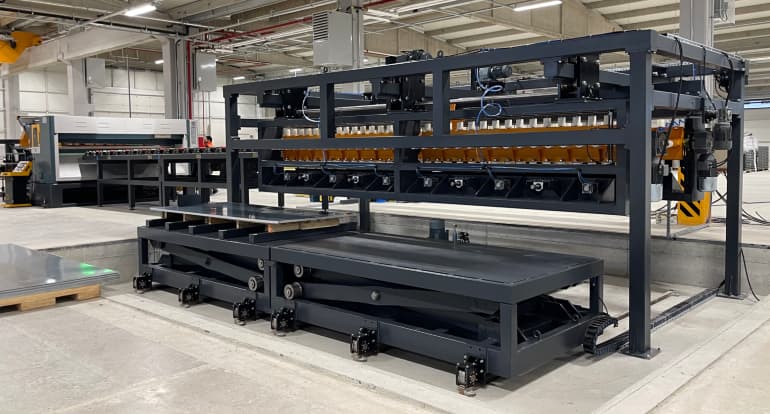
However fast the line is, if the sheets cannot be stacked properly production jams right there and two operators end up tied to the stacker. We explain how the unit that automates this works on the automatic stacker page.
What to check:
- Stack height and weight — does it suit pallets your forklift can handle?
- Surface protection — with scratch-prone material (stainless, pre-painted) you may need interleaving or PVC film.
- Edge alignment — a poorly aligned stack costs time at the next machine.
If you process painted and stainless sheet, a PVC film applicator can be integrated into the line, applying the protective film before the sheet is cut.
5. Decoiler capacity sets the ceiling of the line#
The capacity of a cut-to-length line is usually limited not by the cutting unit but by the decoiler. If the decoiler takes 5-tonne coils, then no matter how fast the rest of the line is, you stop and change coil every 5 tonnes.
You can calculate coil weight from outer diameter, core diameter and width — the coil calculator does it instantly, and we explain the method in how to calculate coil weight and length.
With heavy coils and frequent changes, a hydraulic decoiler plus loading car saves substantial operator time. To see which type suits you, check the hydraulic vs mechanical decoiler comparison.
6. Line components: be clear on what is included#
A standard cut-to-length line contains these units:
| Unit | Function |
|---|---|
| Decoiler | Carries the coil and unwinds it under control |
| Loading car | Aligns and seats the coil on the shaft |
| Straightener / leveller | Removes coil set and shape defects |
| Feeder | Sets sheet length in measured steps |
| Shear | Cuts across the strip |
| Stacking unit | Stacks the sheets squarely |
| PVC applicator | Applies protective film (optional) |
Keep this list beside you when comparing quotes. The price gap between two offers is often hidden not in quality but in scope — a loading car or a stacking unit may have been left out.
On the control side, Servosteel lines are built on Schneider Lexium and Altivar drives; the line runs from a single panel and spare-part access benefits from a widely available brand.
What to prepare before selecting#
Have these four ready when requesting a quote:
- Coil weight and width — determines decoiler capacity
- Sheet thickness range and grade — determines leveller and cutting unit
- Sheet length range and volume — answers the shear-versus-flying-shear question
- Flatness tolerance (as a number) — determines the leveller type
Conclusion#
On a cut-to-length line the cutting unit drives the price, but the leveller drives satisfaction. If budget is tight, simplifying on the cutting side always hurts less than simplifying on the levelling side — there is no way to flatten a sheet after the fact.
Review our cut-to-length lines page and request a quote with the four items above.
Frequently asked questions
What is the difference between a cut-to-length line and a slitting line?
The cutting direction. A slitting line cuts along the strip into narrower strips; a cut-to-length line cuts across it and produces flat sheets.
Should I choose a stop-and-cut shear or a flying shear?
With short sheets in high volume, a flying shear keeps the line moving and pays for itself by removing stoppage time. With long sheets in low volume, a stop-and-cut shear is sufficient and economical, and it gives a clean cut edge.
Can a simple straightener remove edge wave?
No. A simple straightener removes coil set. Edge wave and defects rooted in internal stress need a cassette-type precision leveller, which adjusts roller pressure zone by zone.
What limits the capacity of a cut-to-length line?
Usually the decoiler rather than the cutting unit. If the decoiler takes 5-tonne coils, the line stops every 5 tonnes for a coil change; with heavy coils and frequent changes, a hydraulic decoiler plus loading car saves substantial operator time.
Related lines and machines
Which line are you looking for?
Leave your name and contact details and tell us briefly which line you need; your request goes straight to our engineering team.
Call Us:+90 216 415 30 05Let's design a line for your project
Send us your profile drawing or capacity requirements — our engineering team will get back to you within 48 hours.