

Roll forming line
Storage Rack Production Line
A line producing the load-bearing rack uprights and beams of logistics warehouses; multi-row mounting holes are punched in-line by servo punches, and dimensional stability is maintained even in thick sheet.
Manufacturer: Servosteel — Istanbul, Türkiye. Our lines run in more than 48 countries. Sheet thickness 1.5 – 5.0 mm · Sheet width 100 – 400 mm · Line speed 5 – 20 m/min
Key features
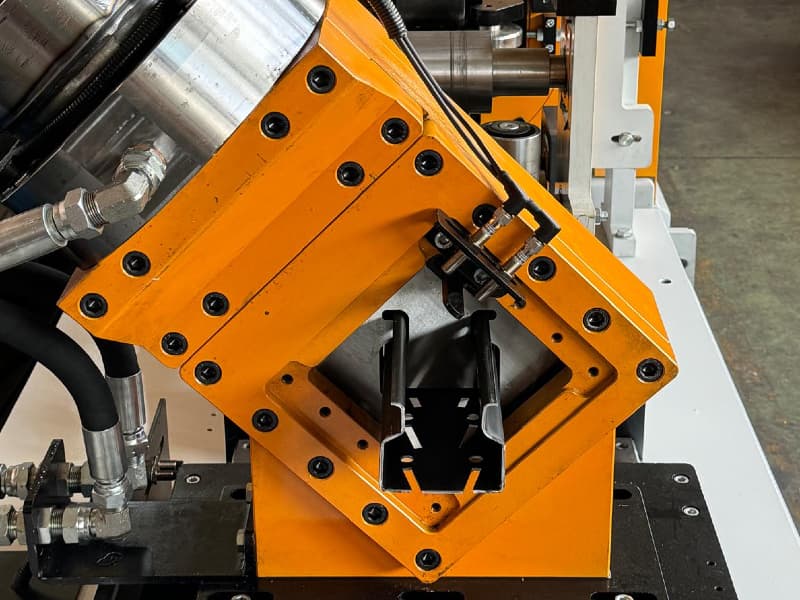
Multi-row punching
The hook holes of upright profiles are punched by servo stations without slowing the line down.
Thick sheet capability
Frame and roll sizing suited to the high wall thicknesses racking systems demand.
Dimensional repeatability
Servo feeding and encoder control keep hole-to-hole precision in serial production.
Profile dimensions and thickness range are defined by your project; roll tooling is designed to your drawing.
Technical specifications
| Specification | Range |
|---|---|
| Sheet thickness | 1.5 – 5.0 mm |
| Sheet width | 100 – 400 mm |
| Line speed | 5 – 20 m/min |
| Roll forming stations | 18 – 30 |
| Total motor power | 15 – 37 kW |
Ranges cover the series; each line is sized to your project according to profile section, material and capacity.
Get a quote for Storage Rack Production Line
Leave your name and contact details and tell us briefly which line you need; your request goes straight to our engineering team.
Call Us:+90 216 415 30 05Production flow
Coil loading and decoiling
Racking is normally rolled from pre-galvanized coil, so the strip arrives with its coating already on it. That governs how the coil is handled from the first metre: the decoiler and the guides are set so the surface is not dragged, because every scratch on a rack upright is a corrosion start point in a warehouse that will be washed down.
Straightening
Coil set is removed before punching rather than after. A strip that still holds curvature feeds unevenly through the punch, and any feed error there turns directly into a hole-position error — which is the one thing a rack profile cannot tolerate.
Multi-row punching
The connector holes are punched flat, in the pattern the rack system uses. The controlling number is not hole size but pitch accumulation: an upright carries connectors along its whole length, so a small repeated feed error adds up over a tall column. Servo feeding with encoder measurement keeps each hole referenced to the run, not just to the hole before it.
Roll forming the perforated strip
Forming a strip that is already perforated is not the same job as forming a solid one. The web is weaker at every hole, so the station sequence is laid out to bring the section up without pulling material across the openings — otherwise the holes deform into ovals and the connector no longer seats square.
Cut in phase with the hole pattern
The cut is not simply to length. It has to land in a fixed relationship to the perforation, so that the first and last holes sit where the rack design expects them on every single upright. A line that cuts to length alone will produce profiles that are the right size and still unusable.
Run-out and stacking
Finished profiles are collected and stacked. Uprights are long and relatively slender, so support spacing on the run-out matters: a profile allowed to sag under its own weight before it is stacked keeps some of that bow, and a bowed upright will not sit plumb in an assembled frame.
Applications
- Warehousing and logistics
- Racking manufacturers
- E-commerce warehouses
- Cold storage
From the field
The rest of the channel
Frequently asked
Common questions
Can uprights and beams run on the same line?
Their sections differ, so two roller sets are normally needed. Depending on your order mix, a single frame carrying two sets can also be built.
How is the hole pattern defined?
It is tooled to the hook pitch of your rack system; pitch and hole shape are project specific. A sample or technical drawing is enough to match your existing system.
What sheet thickness does the line handle?
Heavy duty rack profiles typically call for thick material; the section and thickness range are sized per project. We define capacity together from your drawing.
Which standards apply to racking, and what do they ask of the production line?
Static pallet racking is designed to EN 15512, with EN 15620 covering manufacturing and installation tolerances and EN 15635 the operation and inspection of the installed system. Racking is a load-bearing structure, so what the line has to guarantee is dimensional: section geometry and hole position within the tolerance the design was calculated at. The design calculation and the CE responsibility belong to the rack system owner — the line has to be able to produce to it repeatably, day after day.
Why does hole pitch accuracy matter more than hole size?
Because pitch error accumulates and hole size does not. A hole slightly oversize is a local fit issue; a feed that is consistently a fraction of a millimetre long puts every hole progressively further out along the upright, and by the top of a tall column the connector will not go in. This is why the punching station is fed by servo with encoder measurement rather than by a mechanical stop, and why the specification you should compare between suppliers is pitch tolerance over the full profile length, not per step.
Which material is used for rack profiles?
Uprights and beams are usually rolled from structural steel in the S350GD to S390GD range, supplied pre-galvanized. The grade is not interchangeable: higher yield strength springs back more, so the same finished section needs different roller geometry and more compensation. It also changes how the perforated web behaves during forming. Send the grade with the drawing — the tooling is designed around it.
Can you match the hole pattern of an existing rack system?
Yes. The punching tooling is made to the pattern, and a sample profile or a dimensioned drawing is enough to reproduce it. One thing worth raising early: connector patterns are often the intellectual property of the rack system owner and some are protected. Deciding what you are entitled to produce is the buyer's call, not the machine builder's — we tool to the pattern you specify.
Are beams produced the same way as uprights?
No, and it is worth separating the two when you plan the investment. Uprights are open perforated sections and the whole line is built around punching accuracy. Beams are usually closed box sections, often formed from two profiles and joined, so the line carries a different station sequence and a joining stage instead of a large punching group. Most racking manufacturers end up with two lines rather than one that compromises on both.
Get a quote for Storage Rack Production Line
Send us your profile drawing or capacity requirements — our engineering team will get back to you within 48 hours.