

Press feeding systems
Automatic Stacker
The last link in a roll forming or cut-to-length line: a unit that collects the cut profile or sheet at line speed and stacks it in pack order. Manual stacking is the step that most limits line speed and most raises the risk of damage; automatic stacking removes that bottleneck.
Key features
Does not cap line speed
Stacking runs to the line's output tempo, so the line never has to slow down or wait for the stack.
Counted packs
Pieces per pack come from the recipe; counting is not left to the operator and the pack leaves ready to ship.
Surface protection
The profile is placed rather than dragged into position, which lowers the risk of scratching on parts with a visible face.
Get a quote for Automatic Stacker
Leave your name and contact details and tell us briefly which line you need; your request goes straight to our engineering team.
Call Us:+90 216 415 30 05Areas of use
- Roll forming manufacturers
- Steel service centres
- Racking and storage systems
- Roofing and facade producers
From the field
The rest of the channel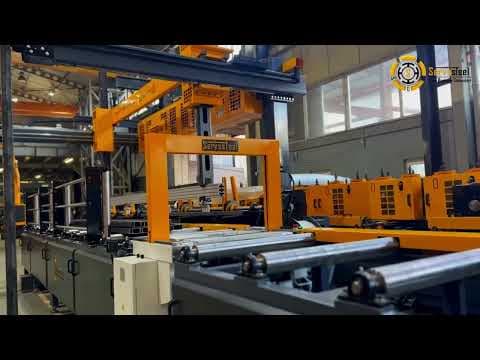
Frequently asked
Common questions
Can it be added to a line I already have?
In most cases yes, but two things decide it: the line's discharge height, and whether the cutting unit can give a signal. The stacker needs a trigger from the cut to know when to move; if the control system cannot expose that signal, an intermediate solution is built. The layout also has to leave clear floor space on the pick-up side for a forklift or pallet truck.
Will the same stacker handle different profile sections?
As long as the section family is similar, yes — the setting changes with the recipe. But profiles with very different width-to-height ratios (a narrow rail versus a wide trapezoidal sheet, say) do not work well on the same holding arrangement. Telling us up front which profile families will run on the line lets us pick the right arrangement.
Does the line have to stop when a pack is complete?
No. When the stacker finishes a pack the table lowers and returns to its empty position while the line keeps running. The time needed to remove the pack is planned against line speed, so there is no pause between packs.
Can the same stacker handle both sheets and profiles?
The collecting principle is the same, but the grippers and stops are laid out around the section being stacked. If you want one unit to take flat sheet off a cut-to-length line and profile off a roll forming line, say so at the outset — the table and stops are designed for it.
Get a quote for Automatic Stacker
Send us your profile drawing or capacity requirements — our engineering team will get back to you within 48 hours.