

Roll forming line
Solar C-Profile Production Line
A line producing hat, C and Omega profiles for solar power plant mounting structures directly from coil; punching stations open the mounting holes in-line, so profiles arrive on site ready to install.
Manufacturer: Servosteel — Istanbul, Türkiye. Our lines run in more than 48 countries. Sheet thickness 1.0 – 3.0 mm · Sheet width 150 – 400 mm · Line speed 10 – 60 m/min
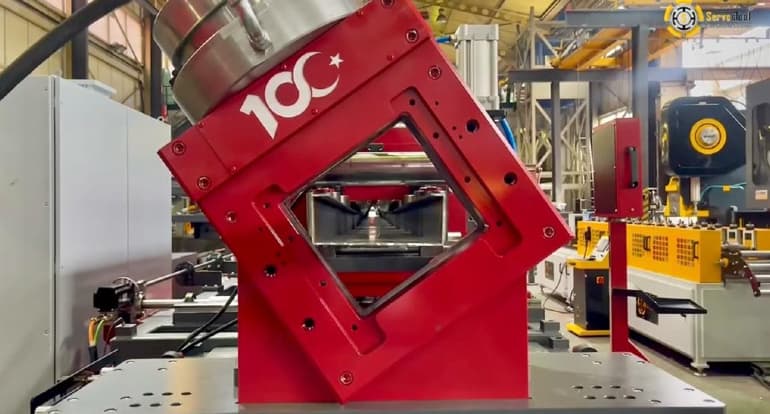
Key features
Profile form to your project
Roll tooling is designed for hat, C, U or Omega sections according to the EPC's structural design.
Suitable for Magnelis® and galvanized
High-corrosion-resistant coated sheets are formed with roll surfaces that protect the coating.
Length and hole recipes
Hole patterns and lengths for different table types are selected as recipes on the HMI.
Profile dimensions and thickness range are defined by your project; roll tooling is designed to your drawing.
Technical specifications
| Specification | Range |
|---|---|
| Sheet thickness | 1.0 – 3.0 mm |
| Sheet width | 150 – 400 mm |
| Line speed | 10 – 60 m/min |
| Roll forming stations | 12 – 22 |
| Total motor power | 15 – 25 kW |
Ranges cover the series; each line is sized to your project according to profile section, material and capacity.
Get a quote for Solar C-Profile Production Line
Leave your name and contact details and tell us briefly which line you need; your request goes straight to our engineering team.
Call Us:+90 216 415 30 05Production flow
Coil loading and decoiling
Solar mounting profiles are almost always rolled from a coated coil — hot-dip galvanized or a zinc-aluminium-magnesium coating such as Magnelis. The coating is the corrosion protection for the whole 25-year life of the plant, so handling from the decoiler onward is set up to avoid scoring the surface rather than simply to move the strip.
Straightening
Coil set is taken out before punching. A solar table is an assembly of long slender members bolted to each other, and a purlin that arrives bowed does not just look wrong — it fights the installer at every bolt and puts the array out of plane, which shows up later as uneven module loading.
In-line punching
Mounting holes and slots are punched flat, before the section is formed. This is what lets the profile go straight from the truck to the structure with no drilling on site. The punch is servo-fed, so the hole pattern follows the recipe for that project rather than being set by mechanical stops that have to be re-adjusted every time the layout changes.
Roll forming
The hat, C or Omega section is built up across the stations. Coated material is the constraint here: the roller surfaces and pressures are set so the coating is not cracked or peeled at the tightest radii, because a bend that has broken the coating is a corrosion site that no amount of paint on site will fix properly.
Flying shear
The profile is cut on the move rather than stopping the line. On a solar job that matters more than it sounds — the order is thousands of pieces in a handful of lengths, and a line that has to decelerate and stop for every cut spends a large part of the shift not producing.
Automatic stacking
Finished profiles are collected and stacked in bundles ready for loading. Solar sites take delivery in large lots on a schedule, so consistent bundling is part of the product: bundles that match the erection sequence save the installer sorting a field full of similar-looking profiles.
Applications
- Solar / EPC companies
- Rooftop PV
- Utility-scale plants
- Agri-PV
From the field
The rest of the channel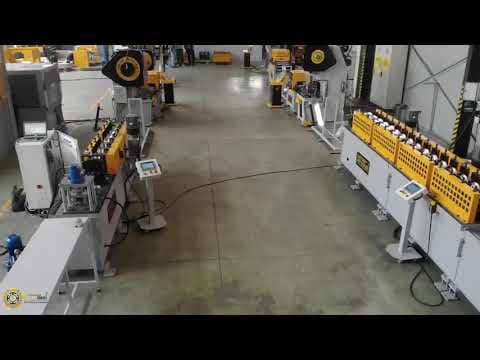
Frequently asked
Common questions
Can I produce both C and U profiles on the same line?
Yes; with a cassette change, C, U and sigma sections run on the same frame. If you switch often, we recommend a quick-change cassette configuration.
Are holes and slots punched inline?
A hydraulic press unit is integrated into the line; mounting holes and adjustment slots are punched before the profile is cut — no second operation needed.
Does hot-dip galvanized sheet suffer in forming?
With roller surface and pressure matched to the coating, it stays intact. Our rollers are made from 4140 steel and hardened to 58-60 Rockwell.
Why is the coating chosen before the profile is designed?
Because it decides both the corrosion life and how the section can be formed. Hot-dip galvanized coil and zinc-aluminium-magnesium coatings such as Magnelis behave differently at a tight radius, and the coating also determines what happens at the cut ends and the punched holes, where bare steel is exposed. Zinc-aluminium-magnesium coatings are chosen partly because they give some self-healing at cut edges, which matters on a profile that is punched and sheared thousands of times. Tell us the coating with the drawing — the roller radii are set for it.
Can holes be punched after forming instead?
It is possible but it is the wrong way round for this product. Punching a formed section means punching through a curved or stiffened area, which distorts the profile locally and leaves a hole that is harder to control dimensionally. Punching flat keeps the pattern accurate and lets the whole thing be done in one pass through the line. The reason solar profiles are punched in line at all is to remove site drilling — doing it afterwards puts that cost straight back.
What does a change in the mounting layout cost on the line?
If it is a change in hole positions or lengths, it is a recipe change and no tooling is involved — that is what the punching stations and the length recipes are for, and it is why solar work suits this kind of line. If the profile section itself changes, that is a roller set question and a different conversation. Worth separating the two when you are planning: layout changes are routine, section changes are not.
Does hot-dip galvanized sheet lose anything during forming?
Not if the radii and pressures are right for it. Zinc coating is more brittle than the steel underneath, so damage shows up as fine cracking on the outside of the tightest bends rather than as visible peeling. That is a tooling design question, decided when the roller set is made rather than adjusted afterwards. It is also why sending the coating specification with the profile drawing is not a formality.
Which sections are normally used for solar mounting structures?
Hat, C and Omega sections cover most of it, in various depths depending on span and wind zone. The structural design is the plant designer's responsibility and it varies a great deal by country — snow and wind loading move the section size more than anything else. We tool to the section on your drawing; if the project is at an earlier stage than that, it is usually more productive to fix the structural design first and specify the line around it than the other way round.
Get a quote for Solar C-Profile Production Line
Send us your profile drawing or capacity requirements — our engineering team will get back to you within 48 hours.