

Roll forming line
Cable Tray Production Line
A complete roll forming line producing cable trays — the backbone of electrical infrastructure — from coil to finished product: decoiler, straightener, servo feeder, punching stations, roll forming machine and cutting unit are managed by a single PLC.
Manufacturer: Servosteel — Istanbul, Türkiye. Our lines run in more than 48 countries. Sheet thickness 0.6 – 3.0 mm · Sheet width 50 – 600 mm · Line speed 8 – 20 m/min
Key features
In-line punching
Ventilation and mounting holes are punched by servo punching stations on the line — no separate operation needed.
Fast size changeover
Recipe-based switching between different tray widths keeps setup times to a minimum.
Galvanized-sheet friendly
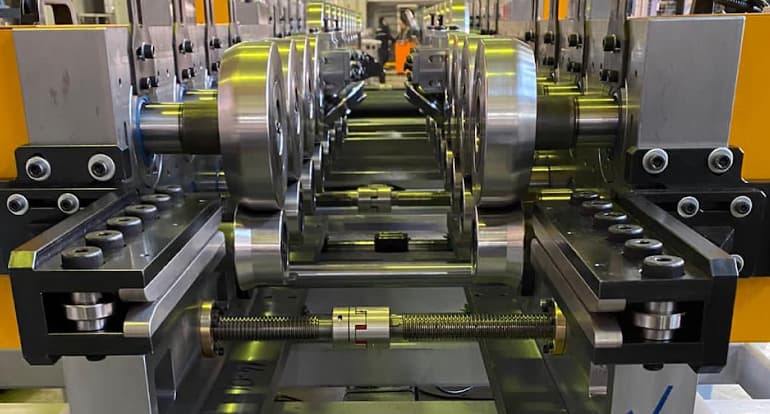
Rolls are machined and hardened to avoid damaging the zinc coating (4140 steel, 58-60 HRC).
Profile dimensions and thickness range are defined by your project; roll tooling is designed to your drawing.
Technical specifications
| Specification | Range |
|---|---|
| Sheet thickness | 0.6 – 3.0 mm |
| Sheet width | 50 – 600 mm |
| Line speed | 8 – 20 m/min |
| Roll forming stations | 18 – 24 |
| Total motor power | 7.5 – 30 kW |
Ranges cover the series; each line is sized to your project according to profile section, material and capacity.
Get a quote for Cable Tray Production Line
Leave your name and contact details and tell us briefly which line you need; your request goes straight to our engineering team.
Call Us:+90 216 415 30 05Production flow
Coil loading and decoiling
Cable tray is usually produced from pre-galvanized coil, and a tray line typically runs several widths from the same stock. That makes coil changing a routine event rather than an occasional one, which is why the decoiler and its loading arrangement have more effect on real output than the forming speed does.
Straightening
Coil set is removed before the strip is punched. A tray is a long shallow channel and it shows curvature clearly once formed; more practically, tray sections are bolted end to end along a run, so a member that is not straight makes every coupler in the run harder to fit.
Perforation and punching
Ventilation slots and the coupler holes at the ends are punched flat. Perforated tray exists for a reason — the openings let heat out of bundled cable and let the tray drain — so the pattern is a functional specification, not decoration. The punch is servo-fed so that the slot pattern and the end holes stay in the right relationship to the finished length.
Roll forming
The channel is formed across the stations. The detail that decides tray quality is the edge: the return flange along the top of each side is what makes a thin shallow channel stiff enough to span between supports, and it is also what cables are dragged across during installation. It is formed to a radius that keeps the section rigid without leaving an edge that damages cable insulation.
Cut to length in phase with the pattern
The cut is timed to the perforation, not just to the length counter. Every tray has to end with the same amount of solid material and the same coupler hole position at both ends, otherwise the joints along a run do not line up. A line that only counts length will make trays that measure correctly and still will not bolt together consistently.
Exit conveyor and stacking
Finished trays run out on a conveyor and are stacked. Tray nests inside itself, so stacking is normally what determines how much goes on a pallet and therefore what shipping costs — which for a low-value high-volume product is a bigger part of the delivered price than most buyers expect.
Applications
- Electrical infrastructure
- Data centres
- Industrial facilities
- Malls and building projects
From the field
The rest of the channel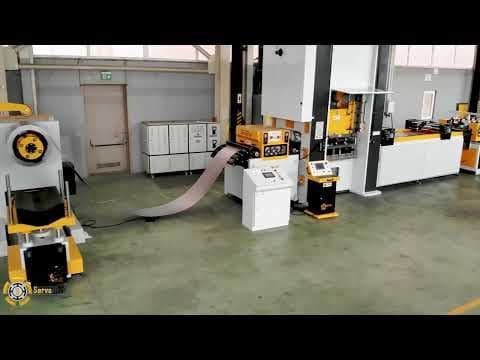
Cable tray production line
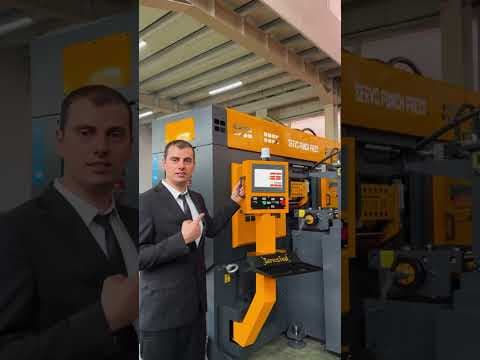
Roll forming line with Servo Punch Press — cable tray and C profile
Frequently asked
Common questions
Can I produce perforated and plain trays on the same line?
Yes. The punching unit is integrated into the line; changing the recipe switches between perforated and plain tray. Hole pattern and pitch are tooled per order.
How long does a size changeover take?
Width is set by the cassette structure; the operator selects the size on the panel and the mechanical adjustment takes minutes. A height change may require swapping the roller set.
Which sheet materials does it handle?
Cold rolled, galvanized, aluminium and stainless steel. To protect the zinc coating, roller surfaces and pressure values are set according to the material.
What is a cable tray roll forming machine?
It is the roll forming machine at the heart of a cable tray production line: strip enters from a decoiler, is straightened and servo-fed, holes and slots are punched in line, and successive roll stations bend the sheet step by step into the tray section before cut-off and stacking. Because the section forms gradually and at room temperature, galvanized and pre-painted sheet keeps its coating — which is why trays are almost always produced from coated coil. On this page the machine is described as part of the complete line, since that is how it is supplied: one manufacturer, one control system, from coil to stacked tray.
Why does the cut have to be phased to the perforation?
Because cable tray is installed as a continuous run of bolted sections. Every piece needs the same solid margin and the same coupler hole position at each end, so that the joints repeat identically down the length of the installation. If the line simply counts length and cuts, the pieces will all measure the same and the perforation will creep relative to the ends, which shows up as couplers that do not line up. Phasing the shear to the punch is what prevents that, and it is a specific thing to ask about when comparing lines.
What actually determines how stiff a tray is?
The return flange along the top edge of each side, far more than the sheet thickness. A plain channel of the same thickness deflects a great deal more, because almost all the stiffness against bending comes from material at the extremes of the section. That is also why the perforation pattern stops short of the edges — perforating the flange takes out the material that is doing the work. If you are comparing trays on thickness alone you are comparing the wrong number.
Does the edge form affect the cables?
Yes, and it is a real installation issue rather than a theoretical one. Cables are pulled along a tray by hand over long runs, and an edge that is left sharp or has a burr from the forming or the shear will score insulation. The return flange is formed to a radius partly for stiffness and partly for this. It is worth looking at a sample piece from any supplier and running a hand along the inside edge — it tells you more about the line than a datasheet does.
How much of the delivered cost is shipping?
More than most buyers assume, which is why tray is usually made close to where it is used. It is a light, bulky, low-value product, so a container fills up long before it reaches its weight limit and the freight is being paid on air. Tray nests inside itself, so how well it stacks directly changes the landed cost. This is also the commercial reason a tray line is often the first roll forming investment for a contractor who was previously buying in — the transport saving alone can carry a large part of the case.
Can the same line make ladder tray and wire mesh tray?
No, and it is worth being clear about it early because the three products are often quoted together. Roll formed tray is a formed sheet channel. Ladder tray is two side rails with rungs welded across, so it needs a welding line rather than a forming line. Wire mesh tray is welded wire, which is a different process again. If your product range covers more than one of these, they are separate investments and should be planned as such.
Get a quote for Cable Tray Production Line
Send us your profile drawing or capacity requirements — our engineering team will get back to you within 48 hours.