

Our expertise
Coil Perforating Lines
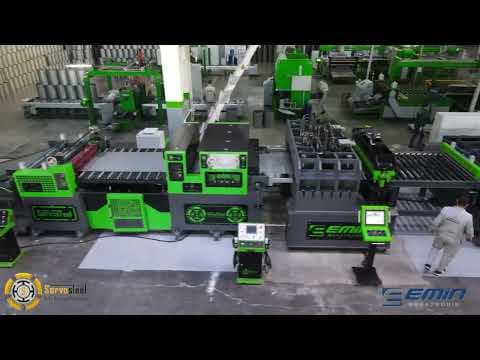
Complete lines that perforate coil to your hole pattern: decoiler, straightener, servo feeder, perforating press, and a recoiler or cut-to-length shear at the exit. Each line is engineered around your pattern, sheet thickness and speed.
From the field
Not brochure promises — running lines: real footage from installations, factory tests and customer sites.
Pattern accuracy
The servo feeder advances the strip by the same pitch on every stroke, so hole rows run true along the sheet.
Multi-punch die
The hole pattern is punched with several punches in one stroke; the die is designed for your pattern and sheet thickness.
Coil or sheet output
The perforated strip can be recoiled, or cut to length and stacked as sheets at the end of the line.
Single-point control
From decoiler to exit, the line runs from one PLC and operator panel; pattern and pitch recipes are stored on the HMI.
Why a Servosteel perforating line?
The first stations of a perforating line — decoiler, straightener and servo feeder — are Servosteel's own products. We build the line around them, together with the perforating press and die, as one project, with every unit sized to the next.
Perforated sheet goes into acoustic panels, ventilation and filter elements, facade cladding, perforated cable trays and shelving. Hole diameter, pitch and open area vary by product, and so does the line: press force, feed pitch and die layout follow the pattern.
For a quotation, send the material, thickness and width range, a drawing of the hole pattern, the required speed and the output format (coil or sheet); we will size the line from there.
Get a quote for Coil Perforating Lines
Leave your name and contact details and tell us briefly which line you need; your request goes straight to our engineering team.
Call Us:+90 216 415 30 05How a perforating line works
- 1
Decoiling
The decoiler carries the coil and feeds the strip into the line under controlled tension; a hydraulic or mechanical decoiler is chosen by coil weight.
- 2
Straightening
Straightener rolls remove coil set. Flat strip is essential for hole rows to stay aligned along the sheet.
- 3
Servo feeding
The servo feeder advances the strip by the pattern pitch on every press stroke. The repeat of the pattern and the spacing between rows are set by this pitch.
- 4
Perforating
A multi-punch die opens one or several rows of holes per stroke. Punch-to-die clearance is set for the sheet thickness and material.
- 5
Exit
The perforated strip is either recoiled, or cut to length on a shear and stacked as sheets.
Hole patterns and open area
Three things define a perforated sheet: hole shape, hole spacing and arrangement. Together they set the open area — the share of the surface taken up by holes.
Round holes
The most common pattern, used in acoustic panels, filters and ventilation elements; the punches are simple and durable.
Square holes
Give more open area than round holes at the same spacing. Common in guard panels, grilles and decorative surfaces.
Slotted holes
Used in ventilation, screens and cable trays. Whether the long side runs along or across the strip affects the sheet's strength.
Decorative patterns
Shaped holes and graded patterns for facades and interiors. The die is designed for the specific pattern.
Closer holes mean more open area and a lighter sheet, but lower strength. A staggered arrangement gives more balanced strength than straight rows at the same open area, which is why it is the most widely used. Tell us the target open area and where the sheet will be used, and we will propose the pattern and die accordingly.
Where perforated sheet is used
Ventilation and filter elements
Housings, grilles and filter cartridges that must let air or liquid through.
Facade and ceiling cladding
Architectural facade panels and suspended ceilings that control daylight and view.
Screens and machine parts
Screens, drying and separating surfaces in agricultural and food machinery.
For profiles such as cable trays, the holes can also be punched inside the roll forming line, so no separate perforating line is needed. Production volume and the hole pattern decide which approach fits.
Frequently asked
Questions about coil perforating lines
What does a perforating line do?
It decoils and straightens the strip, then punches the hole pattern continuously in the press. At the exit the perforated strip is recoiled, or cut to length and stacked as sheets.
Which hole patterns can be produced?
Round, square, slotted and decorative holes, in straight or staggered rows. The pattern is set by the die, which is designed for hole size, pitch and sheet thickness. Send us your pattern drawing and we will assess it.
Does perforated sheet come out as coil or as sheets?
Either. A recoiler is added at the end of the line for coil output; a cut-to-length shear and stacker for sheet output. Which one fits depends on how your customers use the sheet.
What do you need for a perforating line quotation?
Material, thickness and width range, coil weight, a drawing of the hole pattern (hole size, pitch, open area), the required speed and the output format.
Let's engineer your perforating line
Send your material, thickness range and hole pattern; we will come back with a line layout and technical offer.