

Our expertise
Coil Slitting Lines
Complete lines that slit wide coils into strips to your exact widths: every unit from decoiler to recoiler is built at the Servosteel facility, factory-tested and commissioned turnkey on site.
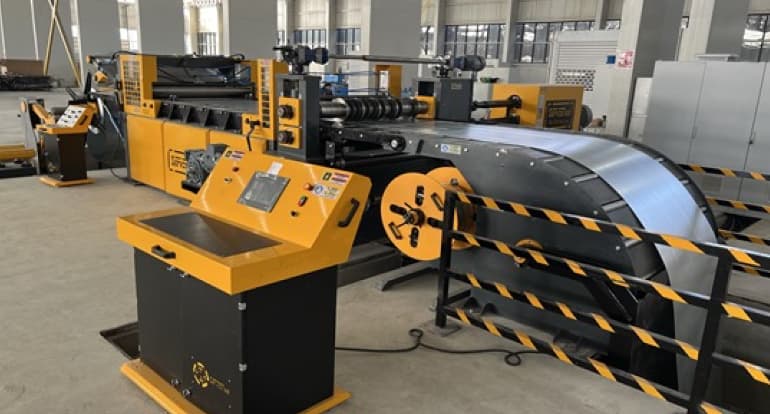
Many strips from one coil
The wide master coil is slit into multiple strips at once, to your order sizes — reducing scrap and stock costs.
Strip width precision
Precise knife setup and controlled tension recoiling keep strip widths within tight tolerances.
Sized to your capacity
Light and heavy-duty frame options for coil weights from 1.5 to 15 tonnes.
Schneider control architecture
Lexium and Altivar based speed control; the whole line is run from a single operator panel.
Capacity and thickness options
| Series | Coil capacity | Sheet thickness |
|---|---|---|
| Light-duty | 1,500 / 2,500 / 3,000 / 4,000 kg | 0.5 – 1 mm · 0.5 – 2 mm |
| Heavy-duty | 6,000 / 8,000 / 10,000 / 15,000 kg | 0.8 – 3 mm · 1.0 – 5 mm |
The values above are standard series; coil width, number of strips and line speed are sized to your project.
Get a quote for Coil Slitting Lines
Leave your name and contact details and tell us briefly which line you need; your request goes straight to our engineering team.
Call Us:+90 216 415 30 05From the field
The rest of the channel
Frequently asked
Common questions about coil slitting lines
What does a coil slitting line do?
It cuts a wide steel coil lengthwise into narrower strips of the width you need, then re-coils those strips. One master coil therefore yields several strips sized to your orders, which lowers both scrap and stock cost.
Which capacity should I choose?
The deciding factor is the maximum coil weight you will process. Light series are built for 1,500–4,000 kg and 0.5–2 mm sheet thickness; heavy series for 6,000–15,000 kg and 0.8–5 mm. Size for your volume 2–3 years out rather than today — the frame cannot be enlarged later.
Should I buy a slitting line or a cut-to-length line?
The difference is the shape of the output. A slitting line cuts the coil lengthwise and the output is still a coil — in narrow strips. A cut-to-length line cuts across the coil and the output is a flat sheet. Choose slitting if you sell strip, cut-to-length if you sell sheet to fixed dimensions. The two can also be combined in one line.
What determines the price of a coil slitting line?
Four things drive it most: coil weight capacity, the sheet thickness range, how many strips are cut at once, and the level of automation (loading car, automatic setsquare, recoiler tension control). That is why we quote per project rather than from a catalogue — send your coil weight, thickness and target strip dimensions and we will size it.
How does commissioning work?
The line is fully assembled and tested at our own facility before shipment, so on site only installation and commissioning remain. That keeps installation time short. Operator training is given during commissioning.
What is the difference between cutting and slitting?
Slitting cuts along the length of the coil and produces narrower coils. Cutting, in the cut-to-length sense, cuts across it and produces flat sheets. Slitting leaves you with coil to feed another process; cut-to-length leaves you with finished sheet.
What are the different types of slitting line?
The cutting principle does not change from one line to the next — circular knives on an arbor, set to the strip widths you need. What separates lines is capacity: coil weight, strip thickness, and how many strips one pass yields. The frame, the drive and the way strips are held under tension on the recoiler scale with those. Choosing between them comes back to your heaviest coil and thickest material — see the capacity question above.
What is a coil processing line?
"Coil processing line" is the umbrella term for the lines that turn a steel coil into a usable form. There are four families: slitting lines cut the coil into narrower strips, cut-to-length lines cut it into flat sheets, roll forming lines shape it into a finished profile, and press feeding systems feed it into a press. Servosteel manufactures all four in one plant in Istanbul, which is why a slitting line and the press feeder behind it can be ordered as one project with one control philosophy.
Related reading
AcademyLet's size your slitting line
Send us your coil weight, sheet thickness and strip widths; we'll define the right series and line layout together.