

Roll forming line
Noise Barrier Production Line
A line producing the aluminium/steel cassette profiles of noise barriers along highways and railways; perforated front (absorber) and closed back panels can be produced on the same line platform.
Manufacturer: Servosteel — Istanbul, Türkiye. Our lines run in more than 48 countries. Sheet thickness 0.3 – 1.5 mm · Sheet width 300 – 800 mm · Line speed 12 – 25 m/min
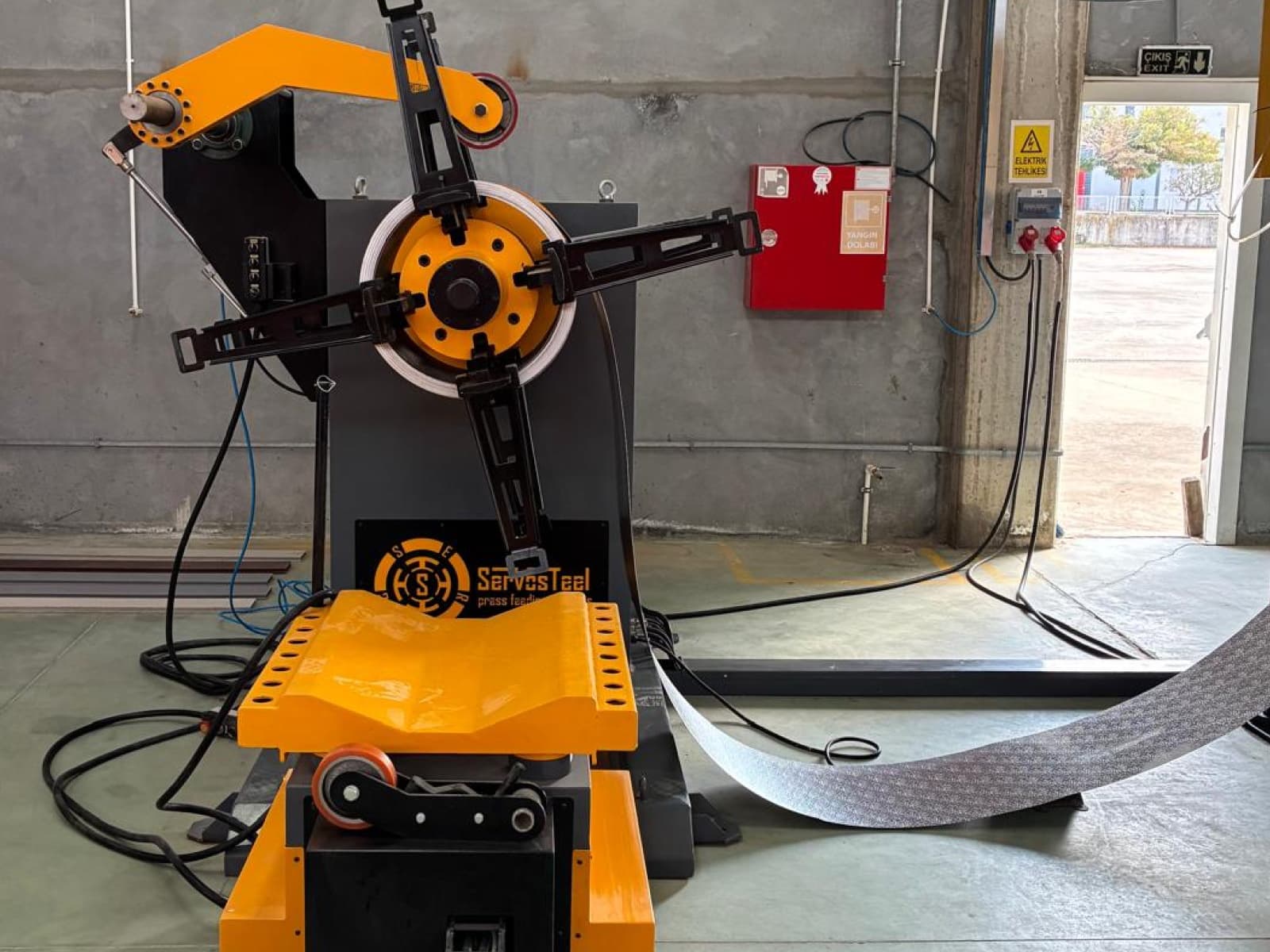
Key features
Perforated panel production
Front-face perforation for acoustic absorption is integrated in-line or before feeding.
Aluminium and steel compatibility
Roll pressure settings for different materials and thicknesses are managed with recipes.
Long panel capability
Precise cut-to-length and safe stacking for barrier module lengths.
Profile dimensions and thickness range are defined by your project; roll tooling is designed to your drawing.
Technical specifications
| Specification | Range |
|---|---|
| Sheet thickness | 0.3 – 1.5 mm |
| Sheet width | 300 – 800 mm |
| Line speed | 12 – 25 m/min |
| Roll forming stations | 16 – 20 |
| Total motor power | 7.5 – 30 kW |
Ranges cover the series; each line is sized to your project according to profile section, material and capacity.
Get a quote for Noise Barrier Production Line
Leave your name and contact details and tell us briefly which line you need; your request goes straight to our engineering team.
Call Us:+90 216 415 30 05Production flow
Coil loading and decoiling
Noise barrier panels are a visible product on a road, and both aluminium and coated steel show every handling mark. The coil is loaded and guided so the face never rubs, and where the coil carries a protective film it is kept on through forming and taken off only after the panel is stacked.
Straightening
The strip is flattened before it reaches the perforation station. This is not only about the finished panel being straight: a strip that still holds coil curvature does not sit flat under the punch, and a perforation punched into a curved sheet comes out with uneven hole edges and a burr that varies across the width.
Perforation of the absorbing face
The front sheet is perforated flat, to the pattern the acoustic design calls for. What matters acoustically is hole diameter together with open area ratio, and both are set by the acoustic engineer rather than by the machine — the line's job is to reproduce that pattern identically panel after panel, because a varying open area means a barrier whose absorption varies along the road.
Keeping the bend zones solid
The perforated field has to stop short of every line the profile will later be bent on. Forming through a perforated zone tears the material at the holes and takes the stiffness out of exactly the edge that carries the panel in its post. So the perforation tool and the forming stations are phased together — the pattern is positioned relative to the finished section, not simply centred on the strip.
Roll forming to material
Aluminium and steel do not run the same way. Aluminium is softer and picks up on the rollers, so it needs lower pressure, different roller surfaces and attention to lubrication; steel takes more pressure and springs back more. The line holds both as recipes rather than being re-set by hand each time the order changes.
Cut to length and stacking
Panels are cut to the module length the barrier layout uses, which is set by the post spacing on the project. Finished panels are stacked with the face protected — a scratch on an absorbing panel is not just cosmetic on aluminium, it is where corrosion starts on coated steel.
Applications
- Highway projects
- Railways and metro
- Environmental engineering
- Urban infrastructure
Frequently asked
Common questions
Are the perforated front panel and cassette back panel made on one line?
They are two different sections, so two roller sets are normally used. For the perforated panel the punching unit is integrated into the line.
Does the hole pattern affect acoustic performance?
Yes; hole diameter and open area ratio directly determine sound absorption. We tool and produce the pattern defined in your acoustic design.
Can you produce aluminium panels?
Yes. Aluminium requires lower pressure and a different roller surface; the line is set up for the material.
Which standards govern noise barriers, and what part of them concerns the line?
Road traffic noise reducing devices are placed on the market under EN 14388, with EN 1793 covering acoustic performance — sound absorption and airborne sound insulation — and EN 1794 the non-acoustic side such as wind load, stone impact and safety in the event of collision. Almost all of that is tested on the finished device, not on the sheet: the cassette with its perforated face, absorbing core and back panel behaves as a system. What the line is responsible for is producing the metalwork to the design consistently, so that the barrier installed is the one that was tested.
Does the perforation pattern really change acoustic performance?
Yes, and it is one of the few things on the panel where a small production drift has an audible result. Absorption depends on hole diameter and open area ratio together with what sits behind the sheet. If open area varies between production runs, the barrier absorbs differently along its length while looking identical. This is why the pattern comes from the acoustic design as a fixed specification and the line reproduces it rather than approximating it.
Why can't the sheet be perforated all the way to the edge?
Because the edges are where the panel is bent and where it carries load. A perforation running into a bend line tears at the holes as the section is formed, and the flange that should hold the panel in its post ends up weakened exactly where it matters. The perforated field is therefore laid out relative to the finished profile, with solid material left at every bend and at the ends. It is a common point of confusion when a panel is being copied from a sample — the visible perforated area is smaller than the sheet.
What changes on the line between aluminium and steel?
Aluminium is softer, marks more easily and tends to pick up on roller surfaces, so it runs at lower pressure with different roller surfaces and more attention to lubrication. Steel takes higher pressure and springs back more, which means different roller geometry for the same finished section. Both can run on one line, but they are set up as separate recipes; if you expect to alternate between them regularly, say so at the enquiry stage so the roller sets are planned for it.
Does the line also assemble the cassette and fill the absorbing core?
No. The roll forming line produces the perforated front profile and the closed back profile. Inserting the mineral wool or other absorbing core, closing the cassette and fitting the end caps is a separate assembly operation with its own equipment. It is worth planning the two together, because the cassette design determines the profile geometry — but they are not the same machine and should be budgeted separately.
Get a quote for Noise Barrier Production Line
Send us your profile drawing or capacity requirements — our engineering team will get back to you within 48 hours.