

How to Choose a Servo Feeder: A Practical Guide
Short answer
Do not select a servo feeder from a single catalogue figure; check three things: peak speed covers your line, roller pressure can be tuned to your material, and synchronization with the press, including pilot release, is fully implemented. Correct sizing needs sheet thickness and grade, strip width, pitch range, press strokes per minute and coil weight. Servosteel standard feeders handle 0.4–4.0 mm thickness and widths up to 1600 mm.
Contents
The servo feeder sets the rhythm of a press line: it delivers strip to the die at the right length, at the right moment, repeatably. When it is chosen wrongly, the problem does not show up in the feeder — it shows up in the part: drifting pitch, lost tolerance, rising scrap.
This guide walks through the parameters to settle before requesting a quote. If you are still weighing a mechanical feeder, start with the servo vs mechanical comparison.
1. What actually determines pitch accuracy?#
The accuracy figure in a catalogue means little on its own; in the field it emerges from three things combined.
Servo motor and gearbox. Closed-loop control corrects position continuously using encoder feedback. In an open-loop system the motor "thinks" it has moved, while in reality it may have slipped.
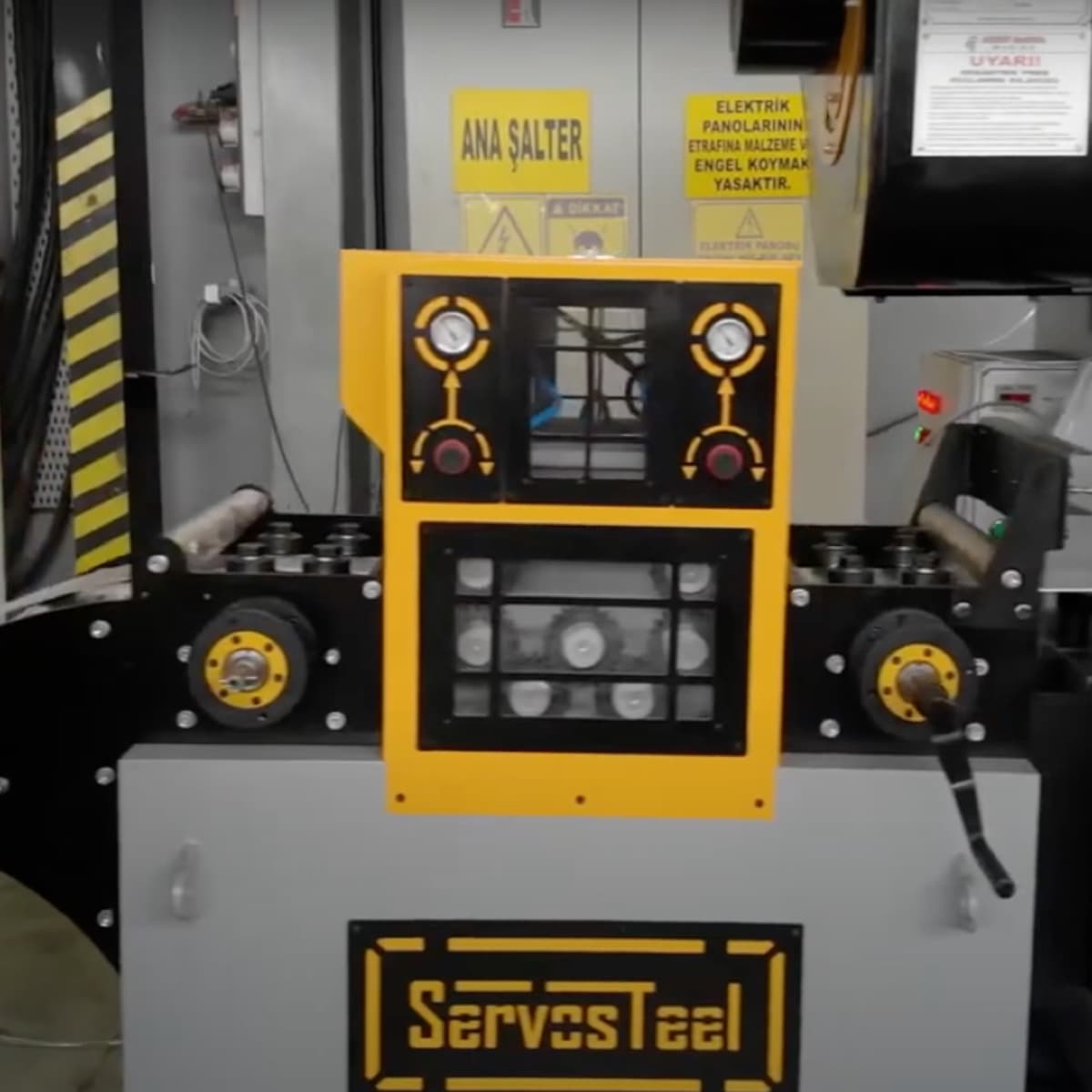
Roller pressure and grip. The strip must not slip between the rollers. Too little pressure and the pitch falls short; too much and it marks the surface and crushes thin material. On Servosteel feeders the feed rollers are Ø85 mm; the larger diameter increases the contact area and reduces slip.
Strip inertia. Heavy, wide strip loads the drive during acceleration and deceleration. The same feeder may not hold on 4 mm material the accuracy it shows on 0.5 mm — which is why you should always ask at what thickness and width the accuracy figure was measured.
2. Feeding speed: do not confuse average with peak#
This is the most common mistake in selection, and it leads directly to buying the wrong machine.
The free feeding speed quoted in catalogues (35 m/min on the Servosteel standard series) is the speed at which the feeder runs uninterrupted. But on a press line it never runs uninterrupted: it stops at every stroke, the press comes down, then it accelerates again.
Average advance is simple:
Average speed (m/min) = pitch (mm) × strokes/min ÷ 1000
For a 250 mm pitch at 40 strokes/min that is 10 m/min. It sounds modest — but the feeder must deliver those 250 mm inside the short window when the press is not closed. The instantaneous peak speed it must reach in that window is several times the average.
Selection is made on peak speed. A feeder chosen from the average comes back from site as "it cannot keep up".
You can work out your own line's output and consumption with the feed calculator.
3. Is the material range right?#
Servosteel standard servo feeders handle 0.4–4.0 mm thickness and strip widths up to 1600 mm. Both ends of that range matter:
- Lower end: on very thin material, pressure that is not finely adjustable crushes and ripples the surface.
- Upper end: thick material needs more holding force; roller pressure and drive torque must cover it.
Stainless and high-strength steel demand more force than mild steel of the same thickness. Share your material list up front.
4. Do you need straightening?#
Strip coming off a coil carries curvature memory (coil set). If that curvature stops the material entering the die cleanly, there are two routes: This series also comes in two bodies: Mini Straightener Servo Feeders and Cased Straightener Servo Feeders.
Separate straightener + feeder — sensible if you are adding to an existing line or the straightening demand is heavy.
Straightener servo feeder — both operations in one frame. The line gets shorter, there is a single control panel, and the synchronization problem between two machines disappears. Roller count follows the material: thin, surface-critical sheet needs more (11–13), thick material fewer (7–9).
If floor space is tight and coils go up to 10 tonnes, a compact line that puts decoiler, straightener and feeder on one platform solves layout and commissioning in a single step.
5. Press synchronization and pilot pins#
The feeder must talk to the press. The press cam signal is wired to the feeder, and feeding is timed against the press dead centre.
Pilot pin release is a critical function: pilot pins in the die pull the strip into its exact position in the last millimetre. For that to happen, the feeder must release its grip at that moment. Without release the pins cannot pull the strip — either a pin breaks or part tolerance drifts.
If you run progressive dies, this function is not optional. We covered the subject separately in progressive dies and servo feeders.
6. Die memory: this is where the real gain is#
If you run long series with a single die, memory hardly matters. If you change dies during a shift, the picture reverses.
Servosteel feeders store recipes for up to 250 dies: pitch, speed, ramp and pressure values are saved under the die name. At changeover the operator picks from the list and setup is done.
That has two effects: changeover drops from minutes to seconds, and dependence on a specific operator disappears. The second is usually worth more — production quality does not fall on the day your experienced operator is away.
7. Mini series or standard series?#
The mini series saves floor space and cost on narrow strip and small presses. Pitch accuracy is identical to the standard series — "mini" does not mean "less accurate". The model lists and size ranges of the two series are on separate pages: Mini Servo Feeders and Cased Servo Feeders.
Its limits are set by strip width and coil weight. If you run narrow strip today but may widen in the near future, the standard series is the safer choice: scaling up a feeder means buying a new machine.
The five numbers you need for selection#
Supply these five and correct sizing takes one round:
| Parameter | Why it is needed |
|---|---|
| Sheet thickness and grade | Holding force and pressure setting |
| Strip width | Roller length and frame selection |
| Pitch (min–max) | Peak speed calculation |
| Press strokes per minute | Peak speed calculation |
| Coil weight | Decoiler capacity and line layout |
If you do not know the coil weight, the coil calculator will give it to you; we explain the method in how to calculate coil weight and length.
Conclusion#
A servo feeder is not selected from a single catalogue figure. Three things decide it: whether peak speed covers your line, whether pressure can be tuned to your material, and whether synchronization with the press — including pilot release — is fully implemented.
For product detail see the servo feeders page, and request a quote with the five numbers above — our engineering team will size it to your line.
Frequently asked questions
Why is average feeding speed different from peak speed?
Average speed is pitch × strokes per minute ÷ 1000, so a 250 mm pitch at 40 strokes/min averages 10 m/min. The feeder must deliver each pitch in the short window when the press is open, so the peak speed it needs is several times the average; select on peak speed.
When should I choose a straightener servo feeder?
When coil set stops the strip entering the die cleanly: straightening and feeding share one frame, the line gets shorter, there is one control panel and no synchronization problem between two machines. Thin, surface-critical sheet needs 11–13 rollers, thick material 7–9.
Is a mini servo feeder less accurate?
No. Pitch accuracy is identical to the standard series; the mini series saves floor space and cost on narrow strip and small presses. If you may widen your strips in the near future, the standard series is safer, because scaling up a feeder means buying a new machine.
What does die memory give you?
Servosteel feeders store pitch, speed, ramp and pressure values for up to 250 dies. Changeover drops from minutes to seconds, and production no longer depends on a specific operator.
Related lines and machines
Which line are you looking for?
Leave your name and contact details and tell us briefly which line you need; your request goes straight to our engineering team.
Call Us:+90 216 415 30 05Let's design a line for your project
Send us your profile drawing or capacity requirements — our engineering team will get back to you within 48 hours.