

How to Choose a Coil Slitting Line: 7 Critical Criteria
Short answer
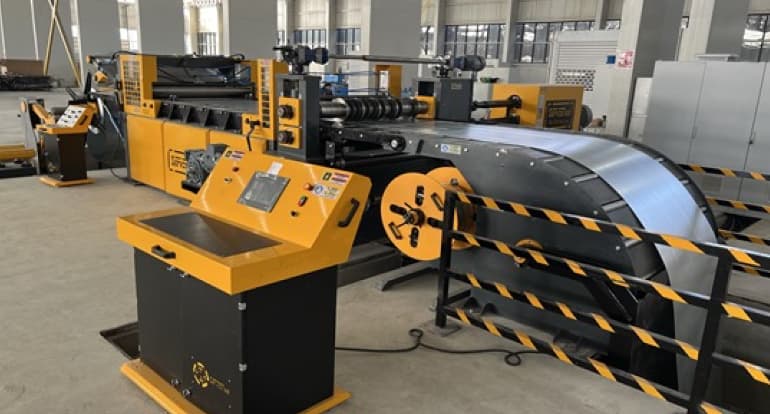
To choose a coil slitting line, first fix maximum coil weight, thickness range and target strip widths, then assess the knife unit, levelling, recoiler tension, automation and the manufacturer's service scope. The practical rule is to take one capacity tier above your heaviest coil, because frames and mandrels cannot be reinforced later. Light series run at 1,500–4,000 kg, heavy series at 6,000–15,000 kg.
Contents
A coil slitting line is an investment that splits a wide steel coil into strips of the required width — and if it is not sized correctly, one of two things happens: either capacity runs out and the line becomes a bottleneck in its first year, or you tie up money in a machine far beyond your needs. Both are expensive, but the first is worse: an undersized line usually cannot be scaled up, because the frame is built for that load from the start.
The 7 criteria below walk through the parameters you should settle before requesting a quote.
1. Coil capacity and weight#
The heart of the line is the maximum coil weight you will process. Light series run in the 1,500–4,000 kg range, heavy series in the 6,000–15,000 kg range.
The most common mistake here is choosing capacity from today's order rather than from the coil your supplier actually delivers. Coil weight is the result of three things: outer diameter, core diameter and width. The same 1,250 mm wide coil weighs about 13 tonnes at a 1,400 mm outer diameter and about 9 tonnes at 1,200 mm. In other words, "a 1,250 coil" does not define capacity on its own.
You can work out the weight of your own coils with the coil calculator and see which tier you fall into. We explain the formula step by step in how to calculate coil weight and length.
A practical rule: take one tier above your heaviest coil. Six tonnes for a 5-tonne coil, ten for an 8-tonne coil. Frames and mandrels cannot be reinforced later, whereas running below capacity is always possible.
2. Sheet thickness and width#
Slitting force depends directly on sheet thickness and on the yield strength of the material. Thin sheet at 0.5–1 mm and thick sheet at 1.0–5 mm require entirely different knife sets and frame rigidity — the difference is not simply "a bigger motor".
With thick material, arbor deflection comes into play: as knives are stacked along the arbor, the cutting force tries to bend it. The more it deflects, the more strip width drifts from centre to edge. This is why heavy-gauge lines use larger arbor diameters and add intermediate supports. If a quotation says "cuts up to 5 mm", ask at what width and how many strips that holds.
Stainless and high-strength steel demand noticeably more force than mild steel of the same thickness. Sharing your material list up front avoids the later surprise of "this line does not cut that".
3. The slitting (knife) unit#
This is the part that determines strip quality, and it is managed through two settings.
Knife clearance is the lateral gap between the upper and lower knife, set as a percentage of sheet thickness. General practice uses low clearance for thin, soft material and higher clearance for thick, hard material. Too little clearance shortens knife life and crushes the edge; too much produces burr and a torn edge. That is why precise and repeatable clearance adjustment is the single most critical feature of the line.
Penetration is how far the knives overlap, and it governs how clean the cut line is.
If you change widths often, a quick knife-change system saves serious time. Building the knife set in a cassette outside the line rather than on it cuts changeover from hours to minutes — in plants that change width more than once a day, that alone justifies the investment.
4. Do you need levelling?#
Coil set — the curvature memory in the coil — causes flatness problems in the finished product. Slitting itself also releases internal stresses: narrow strips cut from a wide coil can curve slightly or show edge wave after separation.
If your customers demand tight flatness, a levelling unit is added to the line. Planning it from the beginning is both cheaper and faster than retrofitting: the leveller sits inside the line, and adding it later means rearranging the layout and the drives.
If your strips will feed a roll forming or tube line — the process is explained in what roll forming is — levelling is close to mandatory — curved strip wanders off centre in the forming line.
5. Recoiler and tension#
When the slit strips are rewound, tension control becomes critical. Loose winding causes telescoping during transport and in the next operation — the coil slides sideways and the edges are damaged.
The second issue is length difference: because of thickness tolerance, strips cut from a wide coil come out slightly different in length. Without separator discs and individual tension control, the short strip pulls tight while the long one stays slack. This is why the tension system must be sized to your number of strips.
Recoiler capacity must also match the decoiler: unwinding a 10-tonne coil onto a 6-tonne recoiler stops the line halfway through.
6. Automation and control#
Single-operator running, speed control and recipe memory determine efficiency. In a plant that changes widths often, storing settings as recipes saves minutes per changeover and reduces dependence on a specific operator.
On Servosteel lines the control architecture is built on Schneider Lexium and Altivar drives, and the whole line is managed from a single panel. Choosing a widely available brand also simplifies spare parts and field service — a custom control board can mean weeks of waiting when a fault occurs.
Scrap calculation: the overlooked cost#
This is rarely discussed during line selection, yet it is the most visible item in annual cost. When the master coil width is not exactly divisible by the strip width, the remainder becomes scrap.
Example: cutting 120 mm strips from a 1,250 mm coil with 10 mm edge trim leaves 1,240 mm usable, which fits 10 strips (1,200 mm) and leaves 40 mm over. With the trim, scrap is 50 mm — that is 4%. Had you been able to run 124 mm strips, you would still get 10 strips from the same coil but with less waste.
Use the slitting yield calculator with your own dimensions. Viewed in annual tonnage, a 2% difference in scrap comes to 200 tonnes a year on a line slitting 10,000 tonnes: steel bought at coil price and sold at scrap price.
Capacity tiers (reference)#
| Series | Coil capacity | Sheet thickness |
|---|---|---|
| Light | 1,500 – 4,000 kg | 0.5 – 2 mm |
| Heavy | 6,000 – 15,000 kg | 0.8 – 5 mm |
7. Manufacturer and service#
The most critical and most often skipped item. Having the line come from a single manufacturer — decoiler through recoiler — eliminates integration problems from the start. On lines assembled from different suppliers, everybody points at everybody else when something goes wrong.
What to settle in the contract:
- Factory acceptance test (FAT) — will the line be tested with your own material before shipment?
- Commissioning — how many days on site, by whom, covering what?
- Spare parts — are critical parts in stock, and what is the lead time?
- Remote support — can the control system be accessed remotely?
Conclusion#
The right line is the one that meets tomorrow's volume, not today's order. Three numbers should be in your hand before deciding: maximum coil weight, thickness range and target strip widths.
With those ready you can review our coil slitting lines page, and we can settle the first link in the chain — decoiler selection — together. If you are unsure between slitting and cut-to-length, see the comparison.
For project-specific sizing, request a quote with your sheet thickness, coil weight and target strip dimensions.
Frequently asked questions
How should I size coil capacity for a slitting line?
Take one tier above your heaviest coil: six tonnes for a 5-tonne coil, ten for an 8-tonne coil. The same 1,250 mm wide coil weighs about 13 tonnes at a 1,400 mm outer diameter and about 9 tonnes at 1,200 mm, so width alone does not define capacity.
What happens if knife clearance is set wrong?
Too little clearance shortens knife life and crushes the edge; too much produces burr and a torn edge. Precise, repeatable clearance adjustment matched to sheet thickness is the most critical feature of the line.
Does a slitting line need a levelling unit?
If your customers demand tight flatness, yes; if the strips feed a roll forming or tube line it is close to mandatory, because curved strip wanders off centre. Planning it from the start is cheaper and faster than retrofitting.
How is slitting scrap calculated?
Subtract edge trim from coil width, find how many strips fit and add the remainder to scrap. Cutting 120 mm strips from a 1,250 mm coil with 10 mm trim gives 10 strips, 40 mm left over and 50 mm total scrap, which is 4%.
Related lines and machines
Which line are you looking for?
Leave your name and contact details and tell us briefly which line you need; your request goes straight to our engineering team.
Call Us:+90 216 415 30 05Let's design a line for your project
Send us your profile drawing or capacity requirements — our engineering team will get back to you within 48 hours.