

Sheet Metal Weight Calculation: Formula, kg/m² Table, Examples
Short answer
Sheet weight is volume × density: Weight (kg) = L × W × t × ρ / 1,000,000, with length, width and thickness in mm and density in g/cm³. The quick check is weight per square metre, which is thickness × density: 1 mm steel weighs 7.85 kg/m². A 1,000 × 2,000 × 2 mm steel sheet therefore weighs 31.4 kg, and plate is calculated the same way.
Contents
Sheet weight comes up long before anything is cut. Steel is bought and quoted by the kilogram, a pack of sheets has to suit the crane, the forklift and the truck, and anyone planning a cut-to-length line wants to know how many sheets one coil will give. All of these come from one formula that fits on a single line.
If you only need the number, use the sheet tool on our calculators page. Below is the reasoning behind it, a reference table and the checks worth doing by hand.
The sheet weight formula#
A sheet is a rectangular block, so its weight is volume × density:
Weight (kg) = L × W × t × ρ / 1,000,000
L (length), W (width) and t (thickness) are in millimetres and ρ (density) is in g/cm³. Dividing by one million converts mm³ × g/cm³ into kilograms. The formula does not care whether you call the material sheet or plate: a 10 mm plate is calculated exactly like a 1 mm sheet.
The shortcut: weight per square metre#
Take one square metre of sheet. Its weight in kilograms is simply the thickness in millimetres × the density:
kg/m² = t (mm) × ρ (g/cm³)
So 1 mm steel weighs 7.85 kg/m². Multiply that by the sheet area in m² and you have the weight. It is also the fastest way to sanity-check a figure from a supplier or a calculator.
| Thickness (mm) | Steel (kg/m²) | Stainless (kg/m²) | Aluminium (kg/m²) |
|---|---|---|---|
| 0.5 | 3.93 | 3.95 | 1.35 |
| 0.8 | 6.28 | 6.32 | 2.16 |
| 1 | 7.85 | 7.90 | 2.70 |
| 1.5 | 11.78 | 11.85 | 4.05 |
| 2 | 15.70 | 15.80 | 5.40 |
| 3 | 23.55 | 23.70 | 8.10 |
| 4 | 31.40 | 31.60 | 10.80 |
| 5 | 39.25 | 39.50 | 13.50 |
| 6 | 47.10 | 47.40 | 16.20 |
| 8 | 62.80 | 63.20 | 21.60 |
| 10 | 78.50 | 79.00 | 27.00 |
Densities used#
| Material | ρ (g/cm³) |
|---|---|
| Steel and galvanized steel | 7.85 |
| Stainless | 7.90 |
| Aluminium | 2.70 |
| Copper | 8.96 |
| Brass | 8.50 |
Brass varies with the alloy, roughly 8.4–8.7; 8.50 is the usual working value. Stainless grades also differ slightly from one another, so for an exact figure use the density stated for the grade you buy.
Worked examples#
Standard sheet: 1,000 × 2,000 × 2 mm, steel
1,000 × 2,000 × 2 × 7.85 / 1,000,000 = 31.4 kg
Check it with the shortcut: the sheet is 2 m² and 2 mm steel is 15.70 kg/m², so 2 × 15.70 = 31.4 kg.
Large sheet: 1,250 × 2,500 × 3 mm, steel
1,250 × 2,500 × 3 × 7.85 / 1,000,000 ≈ 73.59 kg
Plate: 1,500 × 3,000 × 10 mm
Steel:     1,500 × 3,000 × 10 × 7.85 / 1,000,000 = 353.25 kg
Aluminium: 1,500 × 3,000 × 10 × 2.70 / 1,000,000 = 121.5 kg
The aluminium plate weighs about a third of the steel one. Getting the material wrong moves the result by a factor of almost three, far more than any measuring error could.
Inches and pounds#
In the US the same formula is used with the density of steel in pounds per cubic inch, about 0.2836 lb/in³:
Weight (lb) = L (in) × W (in) × t (in) × 0.2836
A 48 × 96 in steel plate, 1/4 in thick: 48 × 96 × 0.25 × 0.2836 ≈ 326.7 lb, or 148.2 kg. That is the same result the metric formula gives for 1,219.2 × 2,438.4 × 6.35 mm.
Pack weight: what the line has to handle#
Sheets leave a cut-to-length line in packs, and the pack is what the crane, the forklift and the truck have to carry. Forty sheets of 1,250 × 2,500 × 3 mm:
40 × 73.59 ≈ 2,944 kg
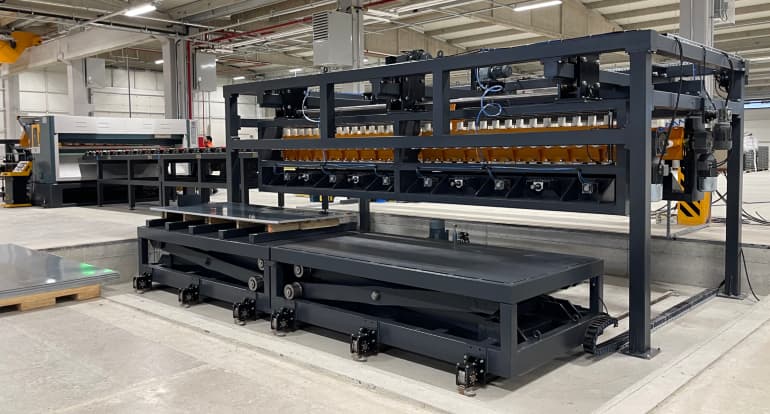
Close to three tonnes on one pallet. That figure decides the stacking table, the pack conveyor and the lifting equipment downstream, which is why it belongs in the line specification from the start. How sheets are counted and stacked automatically is covered on the automatic stacker page.
How many sheets from one coil?#
This is the question a cut-to-length line answers every day. There are two routes, and both should give the same number:
Sheets = strip length / sheet length
Sheets = coil weight / sheet weight
Take the coil from our coil weight and length article: 1,400 mm outer diameter, 508 mm core, 1,250 mm wide, 2 mm steel. It weighs about 13,116 kg and holds about 668 m of strip. Cut to 2,500 mm sheets:
Sheet weight: 1,250 × 2,500 × 2 × 7.85 / 1,000,000 ≈ 49.06 kg
By length:    668,349 / 2,500 ≈ 267.3
By weight:    13,116 / 49.06 ≈ 267.3
That is 267 full sheets, and the remaining 849 mm (about 16.7 kg) is too short for another one. The head and tail of a coil are usually trimmed as well, so plan for slightly fewer. If the offcut matters, a sheet length that divides the coil better is the cheapest fix; the other levers are covered in reducing sheet metal scrap.
Galvanized sheet: the coating weight#
The densities above are for the base metal; the zinc layer comes on top. A Z275 coating means 275 g/m² over both faces, which is 0.275 kg/m² extra:
1 mm:   7.85 + 0.275 = 8.125 kg/m²   (+3.5%)
0.5 mm: 3.925 + 0.275 = 4.2 kg/m²    (+7%)
The thinner the sheet, the larger the share of the coating. Our calculator uses the steel density for galvanized sheet and leaves the coating out, so add it yourself where the difference matters.
Three common mistakes#
Mixing units. Every length in the formula must be in millimetres. Entering the sheet length in metres makes the result a thousand times too small, a slip that is easy to make in a quick spreadsheet.
Trusting the nominal thickness. Weight is directly proportional to thickness. A 1,250 × 2,500 mm sheet sold as 2 mm that actually measures 2.1 mm is 5% heavier: 51.52 kg instead of 49.06 kg. When you buy or sell by the kilogram, that gap counts.
Using the wrong density. Aluminium at 2.70 against steel at 7.85 is a factor of almost three. Taking stainless at 7.90 for a mild steel job changes little; taking steel for an aluminium job ruins the estimate.
Summary#
Sheet weight is length × width × thickness × density, divided by one million when you work in mm and g/cm³. Weight per square metre is thickness × density, and 7.85 kg/m² per millimetre of steel is the number worth remembering. With those two, pack weights and sheets per coil follow directly.
Try your own figures with the sheet calculator. If you are sizing a line that turns coils into sheets, our guide to choosing a cut-to-length line is the next step, or get in touch.
Frequently asked questions
How much does 1 mm steel sheet weigh per square metre?
7.85 kg/m², because weight per square metre is simply thickness in mm × density in g/cm³. Stainless at 1 mm is 7.90 kg/m² and aluminium 2.70 kg/m². Multiply by the sheet area in m² and you have the sheet weight.
How do I calculate the weight of a steel plate?
With exactly the same formula as sheet: length × width × thickness × density / 1,000,000, in mm and g/cm³. A 1,500 × 3,000 × 10 mm steel plate weighs 353.25 kg; the same plate in aluminium weighs 121.5 kg.
Does galvanizing change the sheet weight?
Slightly. A Z275 coating adds 275 g/m² over both faces, i.e. 0.275 kg/m². On 1 mm sheet that is about 3.5% more than bare steel, on 0.5 mm about 7%, so it matters most on thin material.
How many sheets can be cut from one coil?
Divide the strip length by the sheet length, or the coil weight by the sheet weight. A 13,116 kg coil of 2 mm steel, 1,250 mm wide, holds about 668 m of strip: that is 267 sheets of 2,500 mm, each weighing 49.06 kg.
Related lines and machines
Which line are you looking for?
Leave your name and contact details and tell us briefly which line you need; your request goes straight to our engineering team.
Call Us:+90 216 415 30 05Let's design a line for your project
Send us your profile drawing or capacity requirements — our engineering team will get back to you within 48 hours.